Scottish Parliament Elections 2026 - Party Manifesto Pledges for Culture
With less than a month to go before the 2026 Scottish elections, we’re closely watching as the political parties publish their manifestos. Several of these manifestos include a section on culture or some reference to it. This page draws together the main references to culture, heritage and creative industries, and key pledges that could impact the sector if each party was elected.
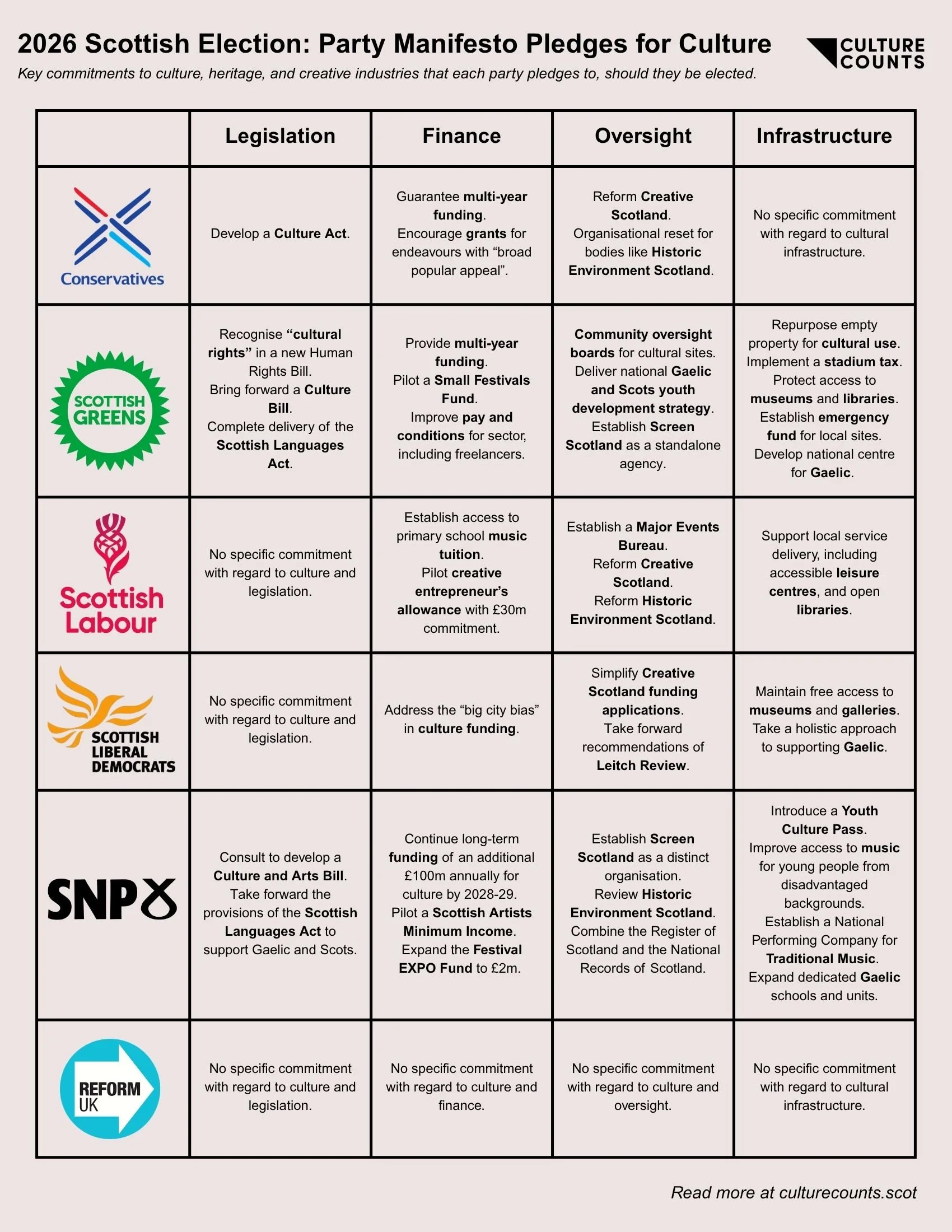
This tracker is up-to-date, and includes all of the party manifestos that have now been published. We have also developed an infographic to summarize they key commitments.
You can also watch all of Scotland’s main political parties make their case for culture at this recording of Scotland’s Cultural Hustings (February 2026), delivered by Culture Counts and our partners the Federation of Scottish Theatre, Scottish Contemporary Arts Network, Festivals Edinburgh, Equal Media and Culture Centre and Campaign for the Arts.
-
Manifesto published 07 April 2026. Pledges to:
Guarantee multi-year funding for cultural organisations through a new Culture Act.
Take the legislative steps necessary to merge some of Scotland’s culture quangos “in order to reduce the costs of running them and allow more money to be delivered to the frontline service offered”.
Retain but reform Creative Scotland, encouraging “grants for arts and cultural endeavours that have broad popular appeal”. Tie grants to “guarantees that free speech is upheld in the institutions that receive them”.
Retain but give “a complete organisational reset” to bodies like Historic Environment Scotland.
Support the tourism industry by “conducting a review into the regulatory barriers that have threatened jobs within the industry”.
-
Manifesto published 14 April 2026. Pledges to:
“Introduce a Human Rights Bill” that includes recognising “cultural rights”, such as the right to, “creative opportunities”.
Support councils, “to revive town centres by repurposing empty commercial property into workspace, cultural and community uses.”
“Bring forward a Culture Bill to make the legislative changes needed to … rebuild our cultural sector, including provision of ongoing and long term multi-year funding.”
“Invest in our grassroots venues and community spaces by introducing a stadium tax – a £1 levy on tickets for all arts, cultural and music events over 2,500 capacity.” The plan is to empower local councils “to administer the levy and collect funds”.
“Protect free access to Scotland’s museums and cultural assets, and review national funding to ensure a fair distribution across the country.” They also plan to “establish an emergency fund to protect local sites from cuts, closures and reduced hours.”
“Support greater community involvement in the management of Scotland’s historic and cultural sites, through the creation of community oversight boards, particularly in rural and island communities.”
“Introduce new conditionality of public funding to Scotland’s museums and cultural assets so that, where appropriate, all recipients should commit to research, interpret, and share the histories of Scotland’s links to empire, colonialism, and historic slavery.”
“Give every primary pupil the opportunity to learn and develop through expressive arts such as music, drama, visual art and dance.”
“Recognise that libraries are considered an essential community service, and ensure that every community has access to a library – public, school, or mobile.” This includes ensuring “that local councils have consistent financial support to keep these community hubs open.”
“Support the development and sustainability of festivals in Scotland’s rural and island communities, who face additional pressures from transport, accommodation and staffing needs, with a pilot Small Festivals Fund.”
“Continue to support the development of both the Gaelic and Scots languages by completing the delivery of the Scottish Languages Act 2025 and ensure that Scots has equal status in law to Gaelic.”
“Support the development of Sabhal Mòr Ostaig as the national centre for Gaelic language, education, and culture including by taking relevant action to ensure Sabhal Mòr Ostaig can be issued degree awarding powers.”
“Deliver a national Gaelic and Scots youth development strategy, ensuring that any child or young person who wants to can access Scotland’s national languages.”
“Improve pay and conditions for arts and cultural workers, including freelancers, by adding greater conditionality on public funding to ensure all workers receive the Real Living Wage.”
“Demand urgent regulation of the use of generative artificial intelligence and copyright laws.” Devolved powers will be employed “to protect creators’ work from big tech’s plans for expanded data scraping.”
“Support greater representation of people from minority ethnic backgrounds working in the arts, including by guaranteeing interviews and directly funding internship and apprenticeship schemes.”
“Review items in the Scottish public collections with the aim to support the restitution and repatriation of looted or unethically acquired items.”
“Support our growing film and TV sector by establishing Screen Scotland as a standalone agency sharing backroom functions with Creative Scotland, and by redirecting all public spending on the screen sector currently delivered via other bodies such as Scottish Enterprise through this single agency.”
-
Manifesto published 13 April 2026. Pledges to:
Establish access to music tuition for all primary school pupils as part of the commitment to ensure that all children get the chance to “succeed and to experience the arts, culture, sport and creative activities”.
Support local service delivery, with specific reference to “accessible leisure centres and open libraries”.
“Establish a Major Events Bureau” to support the Edinburgh Festivals and Scottish Events Campus, while “positioning Scotland as leading destination for world‑class sport, culture, and international conferences.”
“Pilot a creative entrepreneur’s allowance, supporting up to 1,000 creatives and artists who have a commercial business plan with their living costs as they establish their enterprise.”
“Reform Creative Scotland” with a focus on “transparency and accountability”. The goal is to “ensure creative funding is put in the hands of artists, supports fair work, and delivers for the sector.”
Collaborate with the Dundee Eden Project to “build on Dundee’s reputation as a creative and cultural destination.”
Reform Historic Environment Scotland “so it is fit for purpose and ensuring funding is properly used to maintain Scottish sites.”
As part of a commitment to invest in the economy, spend “£30m on a Creative Entrepreneurs Allowance.”
-
Manifesto published 17 April 2026. Pledges to:
Remove the “needless bureaucracy faced by those applying for funding through Creative Scotland”, and take forward “the recommendations of the Leitch Review.”
Address the “big city bias” in how funding for culture is distributed.
Address the “post-Brexit regulations that have made touring unviable for many artists and resulted in lost earnings.”
Maintain “free access to national museums and galleries.”
Support “the creation of Dundee’s Eden Project.”
“Take a holistic approach to supporting Gaelic, empowering Gaelic-speaking communities to make decisions about how to best sustain their language and culture.”
-
Manifesto published 16 April 2026. Pledges to:
Consult “to develop a Culture and Arts Bill” by the end of next parliament, guided by learnings from similar legislation in other European countries.
Continue delivering “a long-term funding settlement for the arts of an additional £100 million annually for culture by 2028-29.” There is an additional commitment of £50 million “delivered for culture investment by the end of the next parliament.”
Pilot a Scottish Artists Minimum Income to support practising artists and creative workers, recognising the cost of equipment and unpredictability of work.
Introduce a Youth Culture Pass, “worth £200 that can be used for cultural pursuits”, given to everyone who turns 18.
Continue supporting “Sistema’s Big Noise programme and the Youth Music Initiative, ensuring that children and young people from disadvantaged backgrounds can continue to participate in high-quality music lessons and fulfil their creative potential.”
Establish Screen Scotland as a distinct organisation, fuded directly by the Scottish Government. Screen Scotland would be tasked with advising on plans to establish a “dedicated Film and TV School at a Scottish university”.
Expand “the Festival EXPO Fund to £2 million by the end of the parliament to support more works at the Edinburgh Festival through the creation of the ‘Festival of Scotland’ programme across all Scottish festivals”.
Establish a National Performing Company for Traditional Music to ensure that the artform receives the same platform that is afforded to the other National Performing Companies.”
Review “Historic Environment Scotland and take any necessary steps to ensure that the recent work of the new Chair is supported and can be embedded for the future”.
Combine the Register of Scotland and the National Records of Scotland to create a “single structure” for achives, registers and records.
Support “further expansion of dedicated Gaelic Medium schools and units, including encouraging Edinburgh to take forward a second GME primary school.”
Take forward the provisions of the Scottish Languages Act to support the Gaelic and Scots languages.
-
Manifesto published 26 March 2026. There are no specific pledges with regards to the culture sector. Pledges on employment, education and training, the reform of Holyrood, housing and communities, energy, transport, and health, social care and welfare will have likely implications for the cultural sector, but these are not specifically explored.